

Gun charges hit hard, and a firearm by a felon case brings a significant risk of a long prison sentence. At Hiltzheimer Law Office, we defend individuals across North Carolina facing firearms violations, DWI, drug offenses, and more. We believe in being accessible when it matters most, which is why we are available days, nights, and weekends. Our clients receive their criminal defense lawyer’s cellphone number for direct communication throughout the legal process.
Our goal is to explain the potential penalties and practical defense strategies under North Carolina and federal law. This guide is for educational purposes and does not constitute legal advice. Every case involving firearm possession is fact-specific, and outcomes can vary widely depending on prior convictions, the circumstances of the arrest, and whether the case proceeds in state or federal court. Because the consequences can be severe, it is critical to understand your rights early and avoid making assumptions about eligibility, defenses, or sentencing exposure without proper legal guidance.
Understanding Felon in Possession of a Firearm Charges
A felon in possession charge arises when a person previously convicted of a felony is accused of owning, possessing, or controlling a gun. Lawmakers designed these statutes to reduce repeat offenses and enhance public safety. Federal statute 18 U.S.C. § 922(g) prohibits certain individuals—including those with a prior felony conviction—from possessing firearms or ammunition.
Federal prosecution is increasingly common. In recent years, thousands of individuals have been convicted annually under section 922(g). Beyond those with a criminal record for felonies, federal law reaches other categories that can complicate a case starting in state court:
- Individuals under certain restraining orders or those with nonviolent misdemeanors related to domestic violence.
- Unlawful users of a controlled substance or those struggling with addiction.
- Fugitives or individuals who entered the country without authorization.
Because state and federal statuses often overlap, a single arrest can trigger multiple legal paths with vastly different sentencing exposures.
Minimum Sentences and Legal Guidelines in North Carolina
The North Carolina legislature has established strict laws regarding firearm possession for those with previous federal convictions. Under the North Carolina General Statutes (G.S. 14-415.1), it is unlawful for a person convicted of a felony to possess any firearm. A violation of the felony firearms act is a Class G felony.
North Carolina utilizes a structured sentencing grid where judges evaluate your criminal history to determine a prison range. While some first-time offenders might receive intermediate punishment, active prison time becomes more likely for individuals with extensive criminal records. For a Class G felony, the presumptive sentence for a defendant with a clean record typically ranges from a minimum of 10 to 13 months, with probation and a suspended sentence as an option, but for those with extensive prior convictions, it can soar to 31 months as a minimum sentence at the higher end of the guidelines.
The court considers the circumstances surrounding the unlawful possession, such as whether the weapon was a concealed weapon or a deadly weapon. Furthermore, if the firearm is brandished or discharged during the commission of another felony, the charge can be elevated to a Class D or even Class C felony, carrying much steeper penalties.
| Topic | North Carolina | Federal Court |
| Governing Law | G.S. 14-415.1 | 18 U.S.C. § 922(g) |
| Offense Level | Class G Felony | Felony Offense |
| Max Penalty | 47 Months (standard Class G) | Up to 15 years (standard) |
| Mandatory Minimums | None (Structured Sentencing) | 15 years (under ACCA) |
| Common Enhancers | Aggravating factors | Serious drug offenses, violent priors |
Federal Implications and Mandatory Minimums
When a case moves to federal court, the stakes escalate. Federal prosecutors often target gun charges involving serious drug offenses or a history of violence. The Armed Career Criminal Act (ACCA) is the most severe mechanism in the federal system. If a defendant has three prior convictions for a “violent felony” or a “serious drug offense,” a conviction triggers a mandatory minimum of 15 years in federal prison. The person is considered a convicted felon.
This 15-year floor is nearly impossible to lower. Federal and state law definitions of what constitutes a “violent” prior are constantly evolving. Recent Supreme Court rulings have narrowed these definitions, but prosecutors still aggressively apply the enhancement. A “serious drug offense” typically involves a state or federal crime punishable by at least 10 years in prison. Even a non-violent sale of a controlled substance from a decade ago can sometimes trigger this life-altering enhancement.
Actual vs. Constructive Firearm Possession
One of the most litigated areas in firearm cases involving felons is the nature of the possession itself.
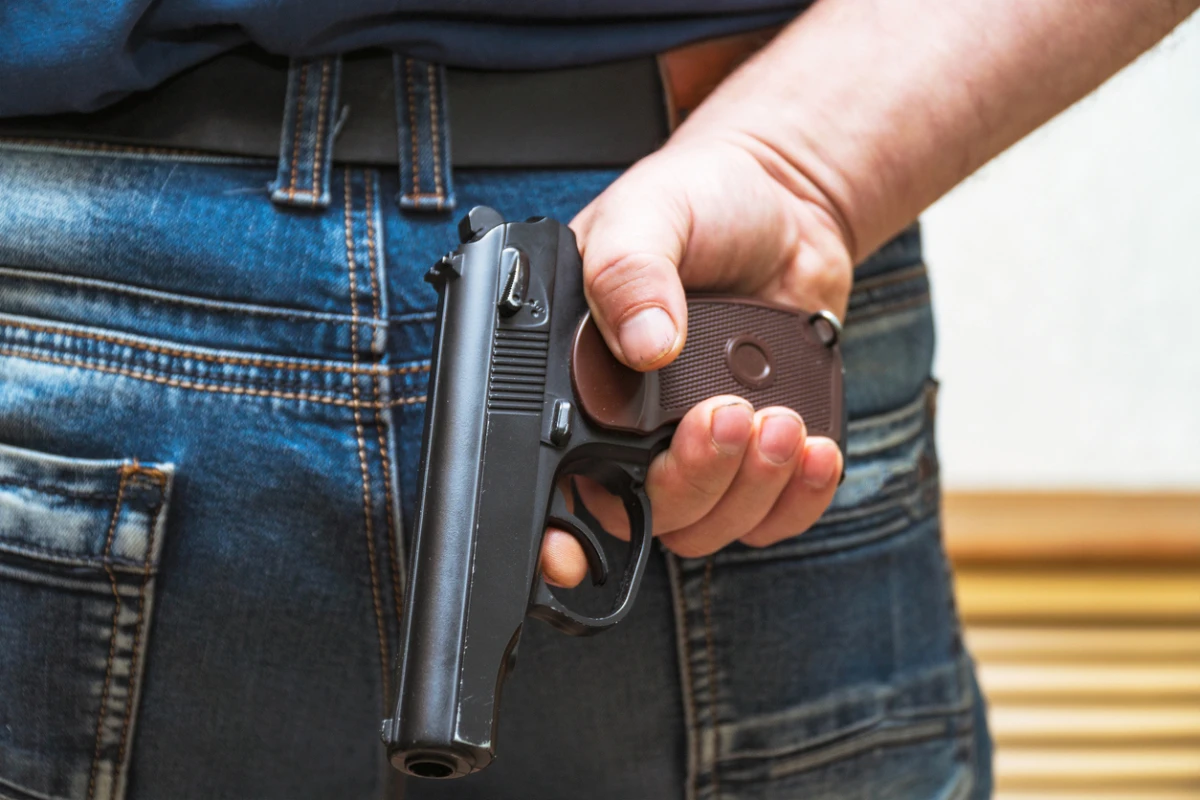
- Actual Felony Possession: This occurs when the firearm is physically on your person—tucked into a waistband, held in a hand, or found in a pocket. These cases are harder to fight, often relying on challenging the legality of the initial police stop.
- Constructive Felony in Possession: This is a much more complex legal theory. Constructive possession applies when the gun is not on you, but the state argues you knew it was there and had the “power and intent” to control it. Common scenarios involve a gun found in a shared glovebox, under a passenger seat, or in a common area of a home.
In North Carolina, mere proximity is not enough for a conviction. Prosecutors must show “incriminating circumstances” linking you to the weapon. For example, if a gun is found in a car with four people, we fight to prove you had no knowledge of its presence or that it belonged exclusively to someone else.
Factors Influencing Sentencing Outcomes Under the Felony Firearms Act
Sentencing is rarely one-size-fits-all. North Carolina judges and federal prosecutors look at the “whole picture” of the firearm’s presence.
- Criminal Backgrounds: A long gap in your criminal record without new criminal charges can serve as a powerful mitigating factor. Conversely, being on probation during the arrest can lead to harsher penalties.
- Nature of the Weapon: While the law covers standard handguns, possessing a firearm muffler, stun guns, or a starter gun can trigger different legal interpretations. “Weapons of mass death and destruction,” such as sawed-off shotguns or fully automatic firearms, carry much heavier weight at sentencing.
- Cooperation and Assistance: In federal court, “substantial assistance” can sometimes provide a “downward departure” from the guidelines. However, this path carries immense risk and must be handled with extreme caution.
Strategies for Reducing Sentence Exposure For Convicted Felons
To achieve a favorable outcome, we analyze every detail of the arrest and the underlying felony.
- Challenging the Illegal Search: If police officers conducted an illegal search or lacked probable cause for a stop, the firearm may be suppressed. Without the physical evidence, the felony charge often collapses. We look for technical errors in search warrants or violations of your Fourth Amendment rights (gun rights).
- Disputing the “Prior Felony” Status: Not all prior convictions qualify. Some old out-of-state convictions do not meet the “substantially similar” requirement in North Carolina, and some juvenile adjudications cannot be used as a predicate.
- Negotiating a Plea Deal: We work with prosecutors to potentially reduce a Class G felony or avoid federal transfer. A well-negotiated plea deal can cap your exposure and avoid the most serious consequences.
- Presenting Mitigating Evidence: We humanize our clients by presenting employment history, family obligations, and evidence of self defense. If you had a gun because of a legitimate threat to your life, that context matters to a judge.
Restoring Rights and Long-Term Implications
In North Carolina, the path to having firearm rights restored is narrow but possible for those with a single felony conviction that was non-violent. This process, governed by G.S. 14-415.4, requires a petition to the Superior Court in your county of residence.
Requirements for restoration include:
- The felony must be “non-violent” (no gun crime of violence, drug trafficking, or domestic violence).
- You must have completed your sentence and had your citizenship rights restored for at least 20 years.
- You must have a clean record with no new criminal convictions since the original felony.
Additionally, if a prior felony conviction is expunged, your right to bear arms may be restored under both North Carolina and federal law. However, the North Carolina legislature amends these rules frequently, so you need a skilled lawyer to verify your current eligibility. It is also vital to remember that state restoration does not always automatically clear your federal “prohibited person” status. This requires separate analysis.
Contact Hiltzheimer Law Office Today
We take gun charges seriously and stand up for our clients at every step. Our team of criminal defense attorneys fights to protect your rights, pursues defenses that fit the facts, and pushes for the strongest result North Carolina law allows. Facing a firearm charge can be overwhelming, especially when you are unsure whether your case will remain in state court or be transferred to federal court. Early intervention can make a significant difference in identifying defenses, preserving evidence, and protecting your future.
If you are ready to talk about your case, call (919) 726-8800 or visit our website, and we will get to work. We welcome your questions, day or night, and we are also here on weekends.